
React Native vs Flutter in 2026: Which to Choose
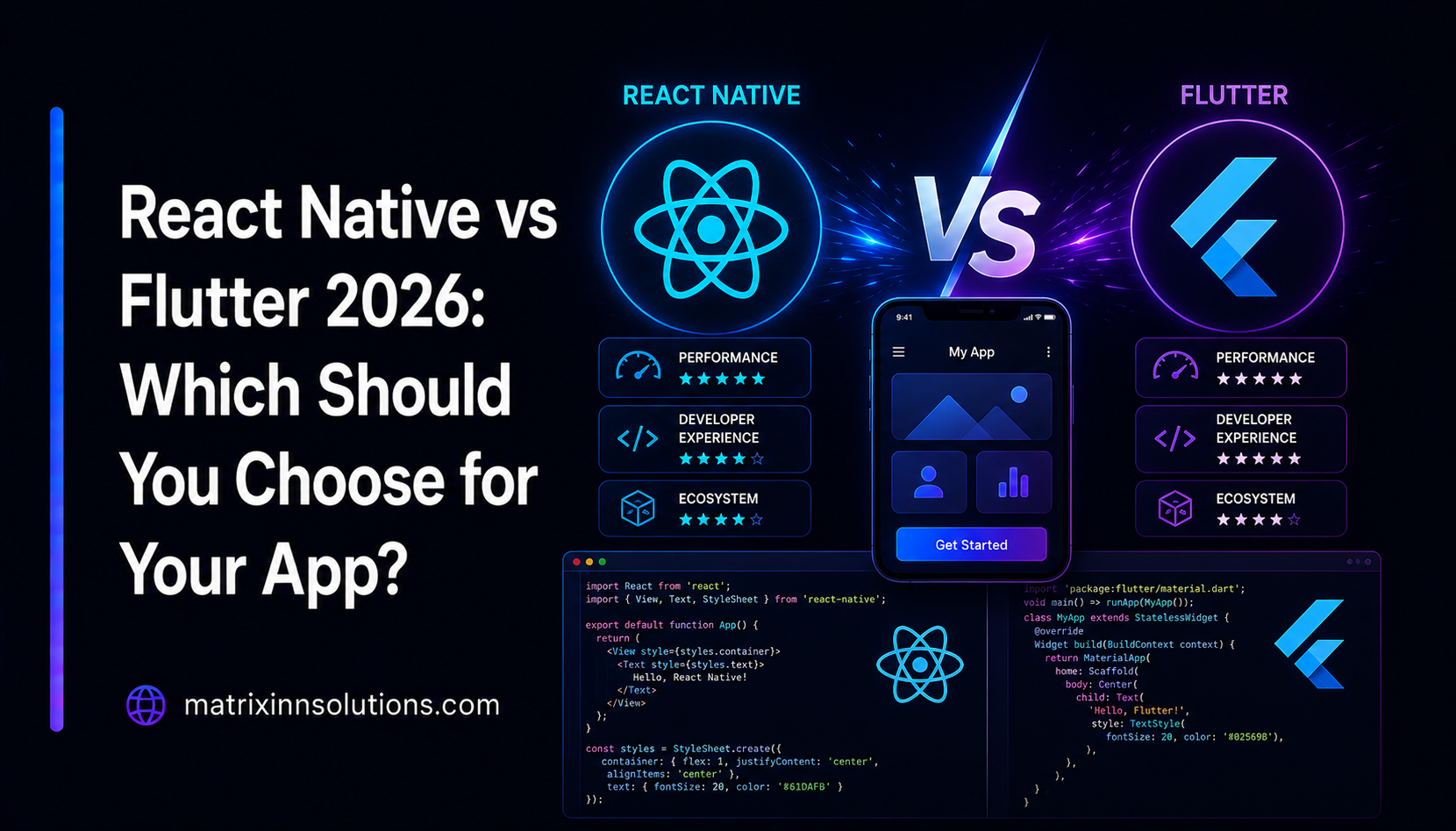
React Native vs Flutter is still the first real decision most teams make when they commit to cross-platform app development. The good news in 2026: both are mature, well-funded, and capable of shipping a polished app to the App Store and Google Play from a single codebase. The honest news: the framework matters far less than how you scope, architect and ship the thing. This guide gives you a clear-eyed comparison and a decision matrix you can actually use.
The honest 2026 state of React Native and Flutter
Both frameworks have crossed the line from "promising" to "default-safe." Either one is a defensible choice for a serious product, so the decision comes down to fit rather than capability. Here is where each stands today.
Performance
Flutter compiles to native ARM machine code and paints every pixel with its own rendering engine. That gives it remarkably consistent frame pacing, which is why it shines on animation-heavy, custom-drawn, and graphics-rich interfaces. React Native renders real native UI components and, with its New Architecture (the Fabric renderer and TurboModules) now standard, has removed most of the old bridge overhead that used to cause jank. For the overwhelming majority of apps — commerce, social, content, dashboards, booking — both deliver smooth experiences and the framework is not your performance ceiling.
Ecosystem & tooling
React Native rides on the entire JavaScript and npm universe, so for almost any third-party SDK, payment provider, or analytics tool there is a maintained package. Expo has become the comfortable default for starting and shipping React Native apps, with over-the-air updates and managed builds. Flutter offers a tighter, more curated package ecosystem; its first-party plugins are exceptionally well maintained, and its tooling — hot reload, DevTools, the analyzer — is famously pleasant. Both have excellent debugging stories in 2026.
Hiring & team skills
This is often the quiet deciding factor. React Native developers are easier to find and frequently overlap with your existing web and React talent, so a team already writing TypeScript can become productive quickly. Flutter uses Dart, which is easy to learn but is a smaller hiring pool; Flutter engineers tend to be specialists who chose the framework deliberately. If you want to share knowledge across web and mobile, React Native has the edge. If you are hiring a dedicated mobile team from scratch, either works.
Decision matrix: choosing by use case
Instead of asking "which is better," ask "which fits this project." Run your situation against these five dimensions — this is the core of any real flutter vs react native 2026 comparison.
- MVP speed. If your founders know React and TypeScript, React Native with Expo gets you to a testable build fastest. If you are starting clean with no web baggage, Flutter's single toolchain and batteries-included widgets are equally quick.
- Design fidelity. Need a bold, fully custom, brand-driven UI with rich motion and identical pixels on every device? Flutter's own rendering engine makes that straightforward. Want your app to feel exactly like the native platform with system components? React Native leans that way.
- Native modules & integrations. If you depend on many third-party SDKs or niche hardware, React Native's larger ecosystem usually has a package already. Flutter covers the common cases well but may need more custom plugin work for the long tail.
- Team skills. Match the framework to the people. Reusing existing JavaScript talent favours React Native; a green-field team with no preference can take either, and Dart is genuinely fast to onboard.
- Maintenance horizon. Both are backed by large organisations and ship regular releases. Plan for periodic upgrades either way; the cost is comparable and dominated by your own dependency choices, not the framework.
Performance reality — and when to reach for Swift or Kotlin
It is worth being blunt: in real products the framework is rarely the slow part. The things that actually make apps feel sluggish are oversized images, chatty network calls, unoptimised lists, and re-render storms — and those are your problem to solve in either framework. Both React Native and Flutter give you the tools to fix them.
There are still cases where you should consider dropping to fully native Swift or Kotlin, or at least writing significant native modules:
- High-end games, 3D and AR where you need direct access to platform graphics and sensor APIs.
- Heavy real-time media — low-latency audio processing, advanced video editing, or live camera pipelines.
- Deep OS integration — rich home-screen widgets, watch and TV apps, App Clips, complex background processing.
- Tight performance or battery budgets where every millisecond and milliamp is accounted for.
The practical pattern most teams land on is cross-platform for the bulk of the app and a thin layer of native code for the few screens that truly need it. That keeps you fast and cost-efficient without compromising the experiences that matter.
Cost & timeline implications
The core economic argument for cross-platform app development holds in 2026: writing most features once for both iOS and Android costs less than building and maintaining two separate native codebases. You get a smaller team, one set of business logic, and a single place to fix most bugs.
A few honest caveats on the cross platform app cost question:
- Savings vary by app type. The more your app relies on platform-specific hardware and OS features, the more native work creeps back in and the smaller the cross-platform discount becomes.
- App store work is not free. Store listings, review, signing, device testing and release pipelines take real effort on both platforms regardless of framework.
- Maintenance is the long tail. Framework and OS upgrades, dependency churn, and new device sizes are ongoing costs. One codebase keeps that bill lower than two.
As a directional rule rather than a quote: a well-scoped cross-platform MVP is typically a weeks-to-a-couple-of-months effort, while a feature-rich production app with a custom backend, integrations and polish is a multi-month engagement. Your scope drives the timeline far more than your choice between React Native and Flutter.
When the choice does not matter
Here is the part vendors rarely say out loud: for most apps, React Native vs Flutter is close to a coin flip, and what actually decides whether you succeed is everything around the framework. A beautifully chosen framework wrapped around a tangled architecture and a chaotic release process will lose to a "boring" framework with clean structure and disciplined shipping every time.
What genuinely moves the needle:
- Architecture. Clear separation of UI, state and data; predictable navigation; a typed API layer; sensible state management instead of a tangle of global variables.
- Delivery. Continuous integration, automated builds, crash and performance monitoring, staged rollouts, and fast feedback loops so you ship small and often.
- Quality. Tests on the logic that matters, real-device QA, and accessibility built in rather than bolted on.
- Scope discipline. Shipping the smallest version that proves value, then iterating with users — in any framework.
Pick the framework that fits your team, then spend your energy on the things above. That is where apps are won or lost.
How MatrixInn chooses the best framework for your mobile app
We are a software house that ships in both — and in native when the app demands it. Our mobile app development team works in React Native, Flutter, Swift and Kotlin, so we are not selling you a hammer and calling everything a nail. We choose per project, against the same questions above.
- React Native when you have or want JavaScript and TypeScript talent, need the broadest SDK ecosystem, or want to share logic with a web product.
- Flutter when design fidelity and rich, consistent motion are central, or when you want one toolchain and a green-field mobile team.
- Native Swift or Kotlin modules layered into either when a feature needs the metal — games, AR, real-time media, deep OS integration.
Whichever we pick, we bring the same architecture and delivery discipline that decides outcomes: typed APIs, sensible state management, CI/CD, monitoring and real-device QA. If you are weighing react native or flutter for your startup, tell us what you are building and who is building it with you, and we will recommend the path — even if that path is "stay native" or "start smaller."