
No-Code vs Custom Development: Which Is Right for Your Project?
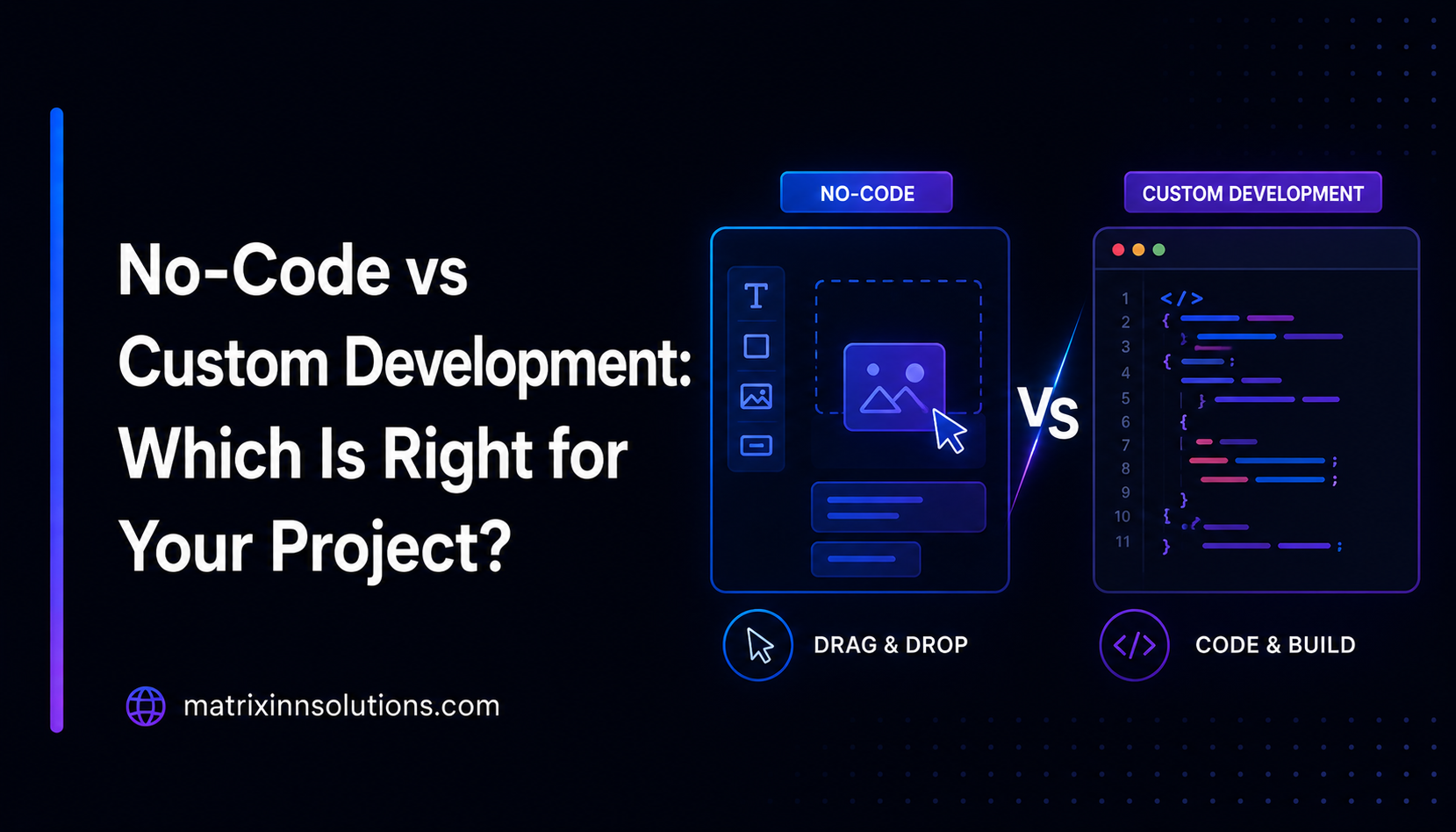
No-code platforms have matured to the point where serious products are being built on them. Webflow powers sites for Fortune 500 companies. Bubble has launched funded SaaS products. Glide and Adalo are building real mobile apps. Yet custom development hasn't gone anywhere — and for good reason.
This guide gives you a clear framework for deciding which approach is right for your specific project, budget, and timeline.
What Is No-Code Development?
No-code development means building software without writing traditional code. Instead, you use visual editors, drag-and-drop interfaces, and pre-built logic blocks. Popular no-code platforms include:
- Web apps: Bubble, Webflow, Softr
- Mobile apps: Glide, Adalo, FlutterFlow
- Websites: Webflow, Squarespace, WordPress
- Automation: Zapier, Make, n8n
- Internal tools: Retool, AppSmith, Glide
- E-commerce: Shopify, WooCommerce
What Is Custom Development?
Custom development means engineers write code from scratch (or from established open-source frameworks) to build exactly what you need. The stack might be React + Node.js, Flutter, Python/Django, Ruby on Rails, or dozens of other options depending on requirements.
The Real Comparison
Speed to Market
No-code wins. A Bubble MVP can launch in 2–8 weeks. A Webflow marketing site can be live in days. Custom development for an equivalent MVP typically takes 3–6 months with a full development team.
If you need to validate an idea quickly or get to market before a competitor, no-code is almost always faster.
Cost
No-code wins (initially).
- No-code MVP: $5,000–$30,000 with an agency, or $0–$5,000 if you DIY
- Custom development MVP: $25,000–$150,000+ depending on complexity
However, no-code has ongoing platform costs ($50–$500/month) and hits scalability ceilings that require expensive rearchitecting. Custom development has higher upfront cost but lower long-term operational costs at scale.
Scalability
Custom development wins. No-code platforms have hard limits: Bubble starts struggling beyond ~1,000 concurrent users without significant optimization. Database query performance, custom caching, complex business logic, and microservices architecture are difficult or impossible in no-code tools.
Custom development can scale to billions of users (that's what the internet runs on). You own the architecture decisions.
Customization
Custom development wins. If your product requires a unique algorithm, custom hardware integrations, complex data processing, proprietary AI models, or anything outside the box of what no-code platforms support — custom code is the only option.
No-code tools impose constraints. Sometimes those constraints are fine. Often they become blockers as your product matures.
Maintenance
No-code wins (short term). Platform updates are handled by the vendor. No server maintenance, no security patching, no dependency upgrades.
But when the platform changes pricing, deprecates features, or gets acquired, you're at their mercy. Platform lock-in is real.
Talent and Team
No-code wins for non-technical founders. You don't need to hire engineers to build and iterate on a no-code product. Any product manager or designer can become a "builder." This is especially valuable for early-stage startups where every hire matters.
When to Choose No-Code
- You're validating a business idea before committing engineering resources
- Your product is within the supported features of a mature platform (Shopify for e-commerce, Bubble for marketplaces)
- You have a tight timeline (trade show, launch event, funding pitch)
- Your team is non-technical and you can't afford senior engineers yet
- You're building an internal tool, dashboard, or admin panel (Retool is excellent for this)
- You expect moderate traffic and straightforward workflows
When to Choose Custom Development
- You've validated the idea and are ready to scale
- Your core value proposition is a unique algorithm or proprietary technology
- You need to handle sensitive data with custom security requirements
- You're integrating with legacy enterprise systems (ERP, mainframes, custom APIs)
- Your business requires real-time features (live collaboration, gaming, financial trading)
- You plan to raise a Series A+ and investors will scrutinize technical architecture
- Platform lock-in is a strategic risk (e.g., Bubble shutting down would kill your company)
The Hybrid Approach
Many successful products start no-code and migrate later. This is a legitimate strategy:
- Validate with no-code. Build on Bubble, get paying customers, understand real user needs.
- Identify the bottlenecks. Where does the platform limit you? What can't you build?
- Rebuild the critical parts in custom code. Often just the core data layer and business logic. Keep the no-code UI where it works.
Alternatively, use no-code for non-core parts: use Webflow for your marketing site while your app is custom-built. Use Zapier for lightweight integrations while your core product is custom code.
Real-World Examples
- No-code MVP, then custom: Many YC-backed startups built their initial product on Bubble, raised seed funding, then rewrote in custom code. The Bubble version was good enough to prove the market.
- No-code forever: Internal tools, dashboards, and B2B SaaS with constrained workflows often stay on no-code platforms indefinitely. Retool-based internal tools run at companies like Amazon, Stripe, and Airbnb.
- Custom from day one: Fintech, healthtech, and deep-tech products typically need custom development from the start due to compliance, performance, and security requirements.
The Bottom Line
No-code is a legitimate tool for early validation and specific use cases. Custom development is the right choice for products that need to scale, differentiate on technology, or handle complex requirements.
The mistake is treating them as ideology rather than tools — choosing one dogmatically regardless of what the project actually needs.
Not sure which approach is right for your project? Talk to our team — we work with both approaches and can give you an honest recommendation based on your specific goals and constraints.