
Next.js vs React in 2026: What's the Difference and Which Should You Use?
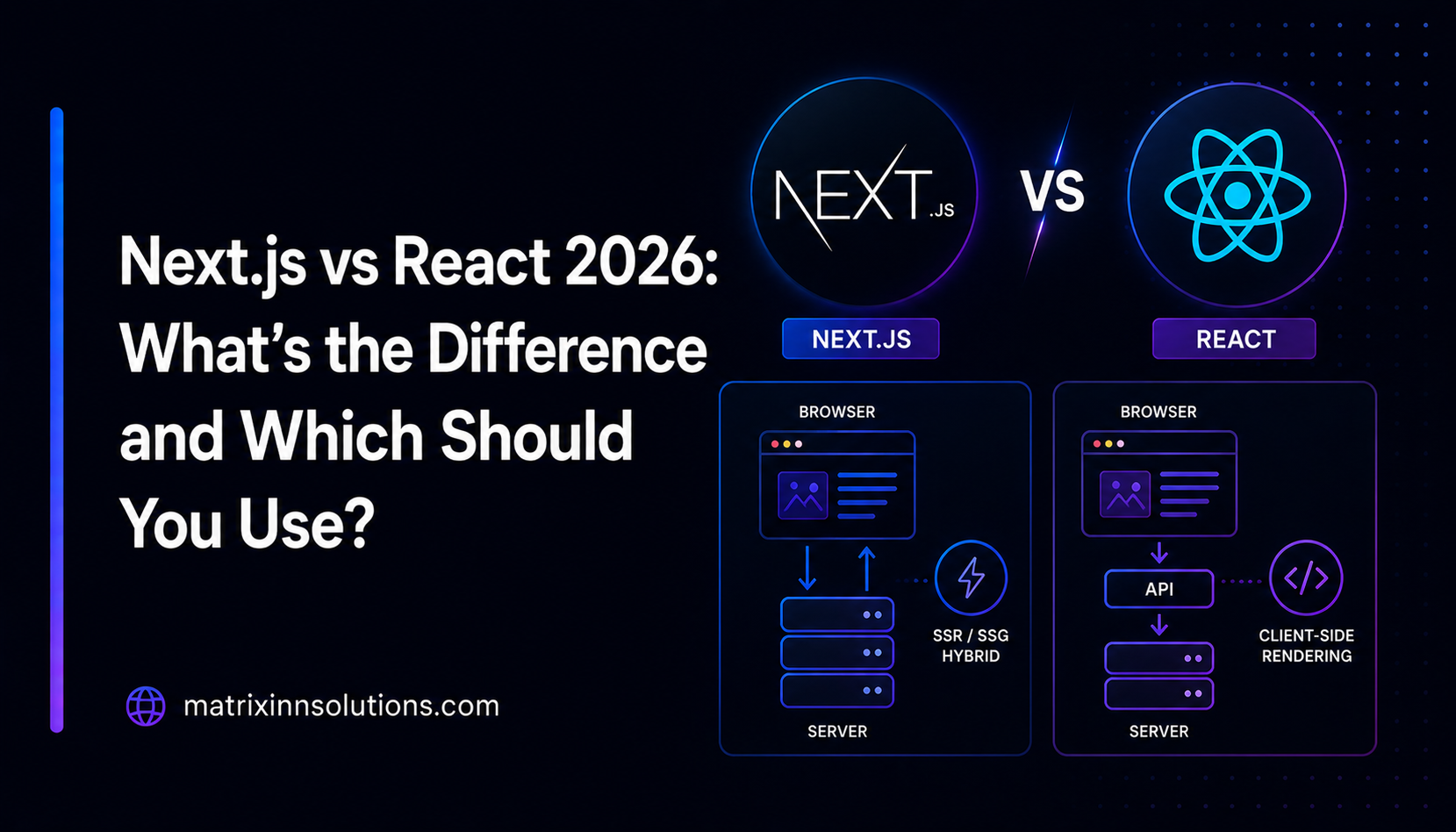
React is the most popular JavaScript library in the world. Next.js is the most popular framework built on top of React. Yet many developers — and nearly all non-technical stakeholders — confuse the two or use them interchangeably. They're not the same thing, and choosing the wrong one for your project has real consequences.
React: What It Is and What It Does
React is a JavaScript library for building user interfaces, created by Meta (Facebook) in 2013. It gives you components, state management, and a virtual DOM — but nothing else. React doesn't care about routing, data fetching, server-side rendering, deployment, or build optimization. That's all up to you.
A plain React app (created with Vite or Create React App) is a Single Page Application (SPA): a single HTML file that loads JavaScript, which then renders the UI entirely in the browser. The server just sends an empty HTML shell.
Next.js: What It Adds
Next.js is a full-stack framework built on React, created by Vercel. It adds everything React doesn't provide:
- File-based routing — create a file, get a route automatically
- Server-Side Rendering (SSR) — render pages on the server for each request
- Static Site Generation (SSG) — pre-render pages at build time
- API Routes — write backend API endpoints in the same project
- Image optimization — automatic WebP conversion, lazy loading, size optimization
- Built-in CSS and font optimization
- React Server Components (App Router) — render components on the server, send HTML to browser
The Key Difference: Where Rendering Happens
React SPA (Client-Side Rendering)
With a plain React SPA:
- Browser requests page
- Server sends empty HTML + large JavaScript bundle
- Browser downloads and parses all JavaScript
- React renders the UI from scratch in the browser
- User sees content
Problem: Step 3–4 can take 2–5 seconds on mobile. Search engines see an empty page until JavaScript executes (bad for SEO). First Contentful Paint is slow.
Next.js SSR/SSG
With Next.js Server-Side Rendering:
- Browser requests page
- Server renders full HTML with content
- Browser immediately shows the rendered page (fast First Contentful Paint)
- React "hydrates" the page to make it interactive
- User sees and can interact with content
Result: Faster initial load, better SEO (Googlebot sees real content), better Core Web Vitals scores.
Next.js App Router vs Pages Router
Next.js 13+ introduced the App Router, a major architectural change. As of 2026, App Router is the standard:
- Pages Router (old):
pages/directory.getServerSidePropsandgetStaticPropsfor data fetching. All components are client-side by default. - App Router (new):
app/directory. React Server Components by default. Data fetching inside components withasync/await. Use'use client'directive for interactive client components.
App Router is more powerful but has a steeper learning curve, especially around understanding when to use Server vs Client Components.
React Server Components (RSC): The 2026 Reality
React Server Components are now stable and central to Next.js App Router. The key concept:
- Server Components — run only on the server. Can directly query databases, call APIs, read files. Send zero JavaScript to the browser. Can't use hooks or browser APIs.
- Client Components — run in the browser (and optionally server-side for SSR). Can use useState, useEffect, and browser APIs. Marked with
'use client'.
The practical benefit: dramatically smaller JavaScript bundles because most of your UI logic stays on the server.
When to Use Plain React
Plain React (with Vite) is still the right choice in specific scenarios:
- Authenticated dashboards — If your entire app is behind a login wall, SEO doesn't matter. A React SPA for a CRM, analytics dashboard, or admin panel is perfectly appropriate.
- Internal tools — Same reasoning. Employees accessing internal tools don't need SSR.
- Browser extensions — Extension popups and options pages are SPAs by nature.
- Electron desktop apps — No server-side rendering needed.
- Simple learning projects — When teaching React fundamentals, SSR complexity gets in the way.
When to Use Next.js
Choose Next.js when:
- SEO matters — Marketing sites, blogs, e-commerce, any public-facing content that needs to rank in search
- Performance matters — Better Core Web Vitals, faster initial loads, especially on mobile
- You need a backend — Next.js API routes let you handle server-side logic without a separate Express server
- Content changes frequently — SSR ensures users always see fresh data
- Content is mostly static — SSG pre-renders pages at build time for maximum performance
- You're deploying to Vercel — First-class Next.js support with zero configuration
Performance Comparison (2026)
On a typical content page (product page, blog post, landing page):
- React SPA: LCP 3–6 seconds on mobile, PageSpeed score 40–60
- Next.js SSG: LCP 0.8–1.5 seconds, PageSpeed score 90–100
- Next.js SSR: LCP 1–2.5 seconds, PageSpeed score 75–90
The difference is dramatic for public-facing pages. For authenticated dashboards, the difference is minimal because SEO and initial load scores matter less.
The Ecosystem in 2026
Next.js has become so dominant that it's now the default starting point for most new React projects — even Vercel's React documentation recommends a framework over raw React for most use cases. Other React frameworks to know:
- Remix — Strong alternative to Next.js, web standards-focused, excellent for forms and mutations
- Astro — Best for content sites; ships zero JavaScript by default, use React only where needed
- TanStack Start — New full-stack React framework from the TanStack team
The Bottom Line
In 2026, the default choice for any new web application should be Next.js — unless you have a specific reason to use plain React. The framework's benefits (SSR, SSG, RSC, built-in routing, image optimization) outweigh the added complexity for virtually all production use cases.
Use plain React when you're building something entirely behind authentication, building a browser extension, or have a specific architectural reason to avoid a framework.
Building a web application and not sure which stack to use? Talk to our team — we've built production Next.js applications for clients across multiple industries.